












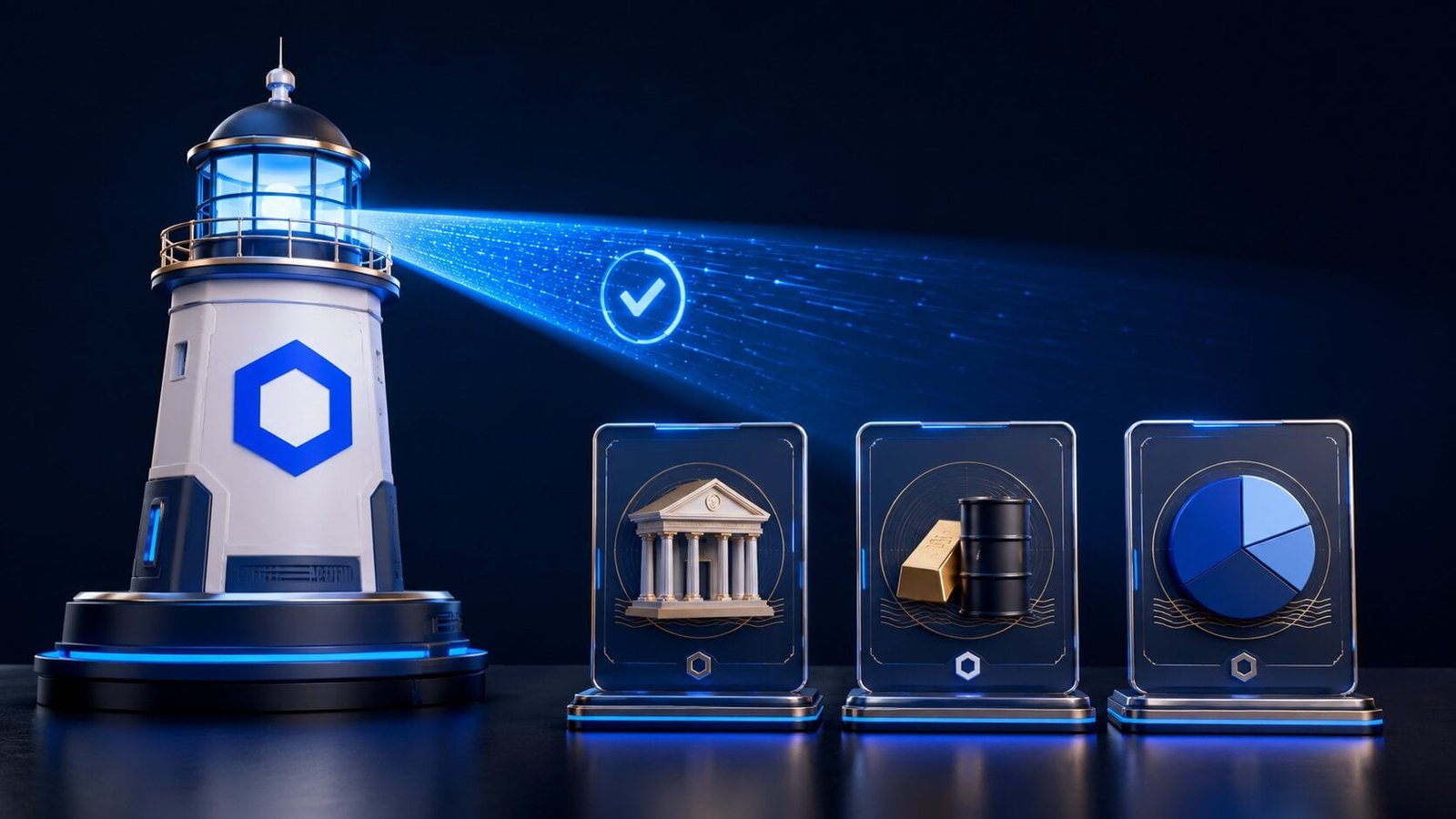
Real-world asset tokenization has become one of crypto’s most serious infrastructure narratives. Instead of focusing only on speculative tokens, the RWA sector is trying to bring assets such as Treasuries, private credit, money market funds, commodities, and other financial instruments onto blockchain rails.
That shift creates a practical problem. Tokenized finance does not work simply because an asset is represented by a token. It needs reliable data, reserve transparency, cross-chain movement, settlement logic, compliance-aware workflows, and connections to existing financial systems.
This is where Chainlink becomes relevant. Chainlink is often described as an oracle network, but its role in tokenized finance now reaches beyond price feeds. Its infrastructure includes off-chain data delivery, Proof of Reserve, cross-chain messaging through CCIP, and institutional tokenization workflows.
For LINK holders and crypto researchers, the key question is not whether RWA is a popular market narrative. It is whether Chainlink can become a useful infrastructure layer for tokenized finance — and whether LINK captures meaningful value from that role.
Key Takeaways
Point Details Chainlink is infrastructure, not an RWA issuer Chainlink does not usually tokenize assets directly. Its role is data, interoperability, automation, and verification. RWA needs trusted information Tokenized funds, Treasuries, credit products, and stablecoins need reliable NAV, reserve, pricing, and settlement data. CCIP is central to the thesis Chainlink’s Cross-Chain Interoperability Protocol supports cross-chain token transfers, messaging, and programmable transfers. LINK value capture is not automatic LINK may benefit if Chainlink usage creates durable fees, staking demand, Payment Abstraction flows, or reserve accumulation. Institutional pilots matter, but they are not guarantees Work with financial institutions is important, but pilots do not automatically translate into token price appreciation. The risks remain significant LINK faces competition, regulatory uncertainty, tokenomics questions, market volatility, and possible delays in RWA adoption.
The RWA Opportunity Is Really an Infrastructure Problem
Tokenized finance is often described as “putting real-world assets on-chain,” but that phrase hides the hard part. A tokenized Treasury product, fund share, or private credit instrument is not useful just because it exists as a blockchain token. It becomes useful when the token reliably represents ownership, stays connected to real-world data, settles correctly, and follows the rules that apply to the underlying asset.
That means tokenized finance needs more than smart contracts. It needs trusted data sources, reserve checks, identity-aware transfer rules, payment connections, and infrastructure that can work across different chains and institutional systems.
RWA.xyz tracks tokenized real-world asset activity across public blockchains, including categories such as tokenized Treasuries, commodities, private credit, stablecoins, and other asset classes. The exact numbers change over time, but the market has already moved beyond theory into measurable on-chain activity. (RWA.xyz)
For investors, the important point is that RWA growth may not only benefit asset issuers. It may also benefit the infrastructure providers that make tokenized assets usable, verifiable, and transferable.
Where Chainlink Fits Into Tokenized Finance
Chainlink’s role in RWA can be understood through four infrastructure layers: data, reserves, interoperability, and institutional workflow integration.
Data for tokenized assets
Blockchains cannot automatically know the net asset value of a fund, the yield of a tokenized Treasury product, the reserves behind a stablecoin, or the price of an off-chain asset. That information has to come from outside the blockchain.
Chainlink’s oracle networks are designed to bring external data on-chain so smart contracts can use it. In DeFi, this has historically meant price feeds. In tokenized finance, the data problem is broader. Tokenized funds and other RWA products may need NAV, AUM, yields, reserve data, corporate actions, and settlement information.
Chainlink’s SmartData product is positioned around bringing financial data such as NAV, AUM, yields, and reserves on-chain for tokenized assets. This matters because tokenized assets need more than a ticker symbol. They need reliable financial context that can move with them across blockchain environments. (Chainlink SmartData)
Reserve transparency
Many tokenized assets depend on off-chain collateral. A stablecoin may claim to be backed by cash and Treasuries. A wrapped asset may claim to be backed by another asset held elsewhere. A tokenized fund may represent claims on a portfolio held by a custodian.
Chainlink Proof of Reserve is designed to verify cross-chain and off-chain reserves backing tokenized and wrapped assets. This can help reduce hidden collateral risk by making reserve information available to smart contracts and market participants. (Chainlink Proof of Reserve)
Proof of Reserve does not remove all trust. Investors still need to understand the issuer, custodian, legal structure, redemption rights, and audit process. However, reserve data can make certain risks more visible and programmable.
Cross-chain movement
RWA markets are unlikely to live on a single blockchain. Institutions may use permissioned systems. DeFi users may use public chains. Liquidity may exist across Ethereum, Layer-2 networks, appchains, and other environments.
Chainlink’s Cross-Chain Interoperability Protocol, or CCIP, is designed for cross-chain token transfers, messaging, and programmable token transfers. In an RWA context, this matters because tokenized assets may need to move between chains while preserving data, permissions, and settlement instructions. (Chainlink CCIP Documentation)
A basic bridge may not be enough for institutional finance. Tokenized assets often need more controlled movement, especially when compliance, transfer restrictions, or institutional settlement processes are involved.
Why LINK Could Have a Role in the RWA Thesis
The LINK token is central to the Chainlink ecosystem, but investors should be precise. “Chainlink is useful” and “LINK must appreciate” are not the same statement.
LINK may matter if Chainlink adoption creates durable demand for network services, staking, fee payments, reserve accumulation, or other mechanisms that connect real usage to token economics. The strength of the LINK thesis depends on whether Chainlink can translate infrastructure demand into measurable value capture.
LINK and staking
Chainlink Staking allows participants to commit LINK in smart contracts to support performance guarantees around oracle services. Chainlink describes staking as part of its Economics 2.0 model, adding a cryptoeconomic security layer to the network. (Chainlink Staking)
This could become more relevant as tokenized finance grows. If more value depends on Chainlink services, the argument for stronger economic security may become more important. However, staking does not eliminate market risk, and reward structures can change over time.
Payment Abstraction and the Chainlink Reserve
One common concern around infrastructure tokens is value capture. If institutions use Chainlink but pay in stablecoins, fiat, or gas tokens, does that help LINK?
Chainlink introduced Payment Abstraction to reduce payment friction by allowing users to pay for Chainlink services in preferred assets while payments can be converted into LINK through Chainlink services and decentralized exchange infrastructure. Chainlink also launched the Chainlink Reserve, designed to accumulate LINK from off-chain and on-chain revenue sources. (Chainlink Reserve Announcement)
This is an important part of the LINK thesis because it attempts to connect broader Chainlink usage with LINK demand. Still, investors should evaluate the scale, timing, transparency, and consistency of these mechanisms rather than assuming they will automatically dominate market supply dynamics.
Institutional Signals: What Matters and What Does Not
Chainlink has attracted attention because of its work with financial institutions and market infrastructure providers. These signals are worth studying, but they should not be treated as automatic investment conclusions.
DTCC Smart NAV pilot
DTCC’s Smart NAV pilot explored how trusted net asset value data could be made available across blockchain networks. DTCC described the pilot as a way to support business workflows by bringing structured, verifiable data to blockchain environments, with Chainlink CCIP serving as an interoperability layer. (DTCC Smart NAV Pilot)
For Chainlink, this is relevant because fund tokenization depends heavily on accurate NAV data. A tokenized fund cannot function properly if the market cannot trust the data that defines its value.
Swift, UBS, and tokenized fund settlement
Swift, UBS Asset Management, and Chainlink completed a pilot under Singapore’s Project Guardian that explored how existing Swift infrastructure could support off-chain cash settlement for tokenized fund subscriptions and redemptions. (Swift, UBS, and Chainlink Pilot)
The practical point is not that traditional finance will immediately move fully on-chain. It is that tokenized finance needs middleware that can connect blockchain networks with existing payment, messaging, and settlement systems.
Investors should distinguish between proof of concept, pilot, production use, and scaled adoption. A pilot can validate technical feasibility, but recurring revenue and broad market usage are stronger signals.
How to Evaluate Chainlink Beyond the RWA Hype
A serious LINK thesis should not rely only on social media narratives. Chainlink may be well positioned for tokenized finance, but investors still need a framework for separating real adoption from market excitement.
Check which Chainlink service is actually being used
Not every Chainlink integration has the same significance. A price feed integration, Proof of Reserve feed, CCIP deployment, SmartData use case, or institutional workflow each has a different impact. The more mission-critical the service, the stronger the infrastructure argument.
Separate adoption from token value capture
Chainlink adoption can be positive for the network, but LINK value capture depends on economics. Investors should look for recurring service payments, staking demand, reserve accumulation, Payment Abstraction flows, and evidence that usage creates measurable demand for LINK.
A weak thesis says: “A major institution tested Chainlink, so LINK must rise.”
A stronger thesis asks: “Does this integration create recurring demand for Chainlink services, and how does that demand interact with LINK?”
Watch cross-chain activity
CCIP is one of Chainlink’s most important RWA-related products. If tokenized assets spread across multiple chains, interoperability becomes more valuable. If institutions mostly use isolated private ledgers, the public-chain opportunity may develop more slowly.
Useful signals include more supported chains, more tokenized asset projects using CCIP, higher message and transfer activity, more institution-facing integrations, and clearer evidence of recurring usage.
Compare Chainlink with competing infrastructure
Chainlink does not operate without competition. Other oracle providers, interoperability protocols, data networks, and institution-built systems may compete for parts of the same market.
Chainlink’s advantage is its established oracle brand, broad DeFi footprint, institutional relationships, and expanding product suite. Its challenge is proving that those advantages can translate into durable economics for the network and LINK token.
Main Risks for LINK and Tokenized Finance
A balanced Chainlink RWA analysis has to include risks. Tokenization may grow, but not necessarily in the way crypto investors expect.
Tokenization may happen in closed systems
Institutions may tokenize assets on permissioned networks with limited public-chain composability. Chainlink could still play a role in that world, but the benefit to open DeFi markets may be slower or narrower than crypto investors hope.
LINK value capture is not guaranteed
Even if Chainlink becomes widely used, LINK’s market performance depends on fee design, staking demand, liquidity, supply dynamics, investor expectations, and broader market conditions. Infrastructure adoption does not always translate directly into token appreciation.
Regulatory uncertainty remains high
Tokenized funds, credit products, securities, and yield-bearing assets may face strict regulatory requirements. Rules vary by jurisdiction and can change. This affects issuers, exchanges, DeFi integrations, custodians, and users.
This article is for educational purposes only and should not be treated as financial, legal, or tax advice.
Smart contract and oracle risks still exist
Chainlink is designed to reduce certain data and interoperability risks, but no system is risk-free. Oracle failures, incorrect data, smart contract bugs, bridge vulnerabilities, governance issues, or integration errors can still create losses.
RWA liquidity can be misunderstood
Tokenization does not automatically make illiquid assets liquid. A tokenized private credit product can still have lockups, limited buyers, redemption restrictions, or thin secondary markets. Investors should read the product terms instead of assuming every tokenized asset trades like a liquid crypto token.
Practical Checklist Before Building a LINK Thesis
Before buying, trading, or researching LINK because of the RWA narrative, use a disciplined checklist.
- Identify the actual Chainlink service: Is the project using Price Feeds, Proof of Reserve, CCIP, SmartData, Automation, or an institutional workflow standard?
- Check whether the integration is live: A production deployment matters more than a vague partnership announcement.
- Look for recurring demand: One-off pilots are less important than repeatable service usage.
- Study LINK value capture: Look for staking demand, Payment Abstraction flows, reserve accumulation, or other measurable economic mechanisms.
- Evaluate the RWA product itself: Tokenized assets still need credible issuers, custodians, redemption rules, legal claims, and compliance controls.
- Watch market expectations: A strong long-term narrative can still be a poor entry if the market has already priced in aggressive growth.
- Define what would disprove the thesis: Weak CCIP adoption, limited institutional usage, stronger competitors, or unclear token economics could all weaken the case.
The goal is not to decide whether LINK is “good” or “bad” based on a headline. The goal is to understand whether Chainlink’s infrastructure is becoming more necessary as tokenized finance matures — and whether that usage creates durable relevance for LINK.
Crypto Daily Perspective
For readers following tokenized finance, Chainlink is one of the infrastructure projects worth monitoring closely. Its RWA relevance comes from the practical needs of tokenized markets: data, reserve verification, cross-chain movement, and institutional connectivity.
Crypto Daily covers these themes to help readers separate durable crypto infrastructure from short-term market hype. As RWA grows, the most important question may not be which tokenized asset launches next, but which networks become necessary for those assets to function safely and efficiently. (Crypto Daily)
Frequently Asked Questions
Is Chainlink an RWA project?
Chainlink is not primarily an RWA issuer. It is an oracle and blockchain infrastructure network that can support RWA applications through data feeds, Proof of Reserve, SmartData, CCIP, and institutional workflow tools.
Why is Chainlink important for tokenized assets?
Tokenized assets need reliable off-chain data, reserve verification, cross-chain communication, and links to existing financial systems. Chainlink provides infrastructure designed to solve several of these problems.
Does LINK directly represent real-world assets?
No. LINK does not represent a Treasury, fund, commodity, or credit product. It is the native token used within the Chainlink ecosystem for functions such as staking, payments, and network economics.
Could RWA adoption increase demand for LINK?
It could, but it is not guaranteed. The thesis depends on whether Chainlink’s RWA-related services create recurring fees, staking demand, Payment Abstraction flows, reserve accumulation, and broader network usage.
What is Chainlink CCIP?
CCIP is Chainlink’s cross-chain interoperability protocol. It allows developers to build applications that transfer tokens, messages, or both across different blockchains.
What are the biggest risks of investing in LINK for the RWA narrative?
Key risks include crypto volatility, uncertain token value capture, competition, regulatory delays, institutional adoption moving slowly, smart contract risk, and market hype getting ahead of real usage.
Is LINK a good long-term RWA investment?
That depends on the investor’s risk tolerance, time horizon, and view of Chainlink’s ability to capture value from tokenized finance. LINK may be relevant to the RWA infrastructure thesis, but it should be researched carefully and not treated as a guaranteed winner.
Disclaimer: This article is provided for informational purposes only. It is not offered or intended to be used as legal, tax, investment, financial, or other advice.