












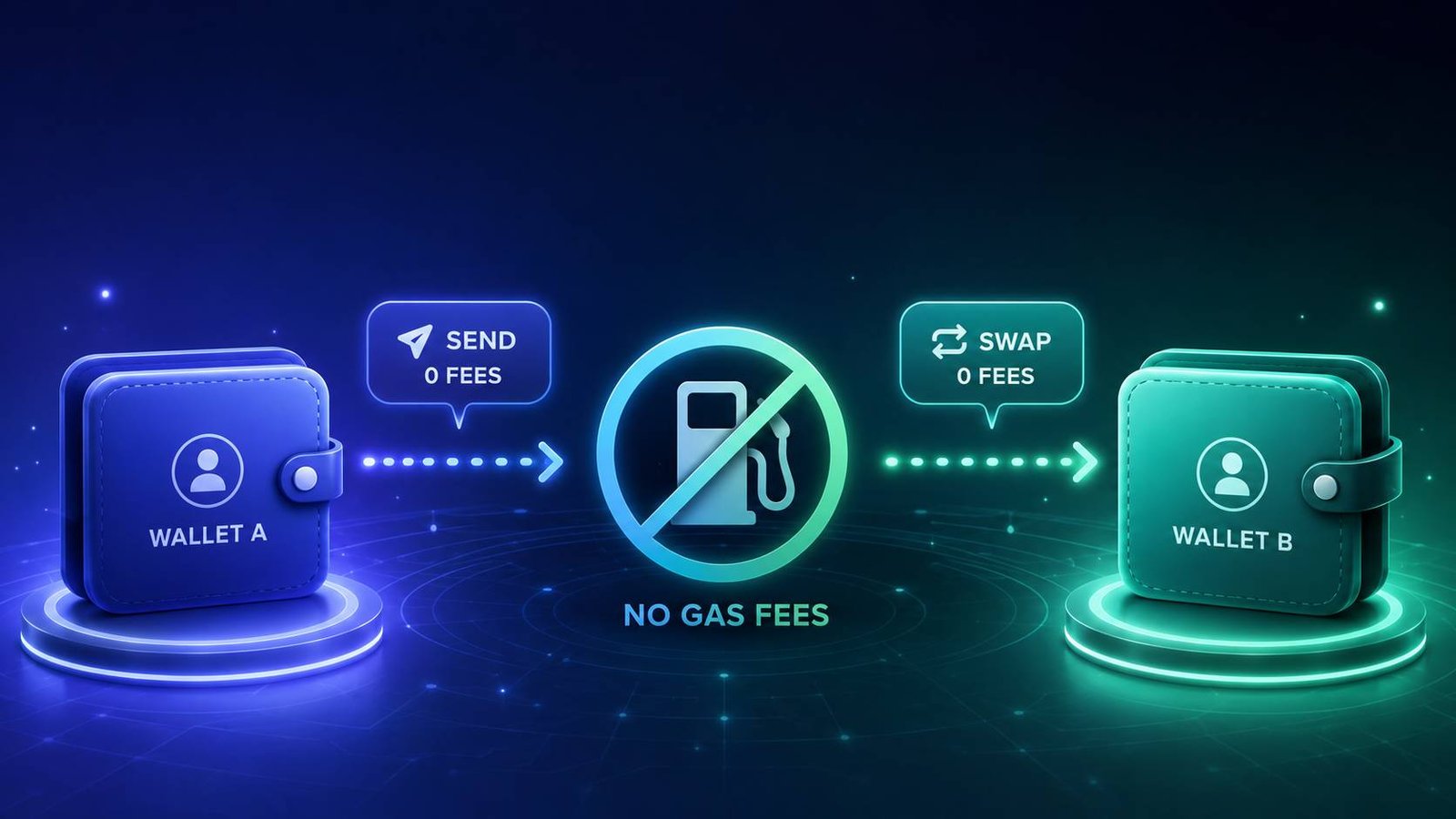
Stablecoin holders run into the same problem every month: USDT and USDC require a separate native token to cover gas fees on most wallets. Send USDT on Tron and the transfer fails without TRX. Move USDC on Ethereum and the wallet asks for ETH first.
A small group of wallets now skips that requirement entirely. Instead of asking users to hold a separate gas token, these wallets take the network fee directly out of the stablecoin being sent. Send 100 USDC and a small portion covers the fee, with no ETH balance needed.
Five gasless stablecoin wallet options stand out in 2026 across coverage, fees, and trade-offs.
Quick Comparison of Gasless Stablecoin Wallets
The table below summarizes how each wallet handles gasless USDT and gasless USDC transfers across its supported networks.
Wallet
Stablecoins Supported
Networks
Fee Per Transfer
Non-Custodial
No KYC
IronWallet
USDT, USDC
Tron, Ethereum
Deducted from stablecoin balance
Yes
Yes
Klever (GasFree)
USDT only
Tron
1 USDT (after 2 USDT activation)
Yes
Yes
NOW Wallet
USDT only
Tron
1.5 USDT flat
Yes
Yes
Guarda
USDT only
Tron
1 USDT flat
Yes
Yes
Unity Wallet
USDT, USDC
9 chains
Bundled into the transfer amount
Yes
Yes
IronWallet: Broadest Multi-Chain Gasless Coverage
IronWallet is a non-custodial multi-chain crypto wallet with no KYC, 10,000+ supported assets, gasless stablecoin transfers, and WalletConnect Pay integration.
The app supports gasless transfers across two networks, which sets it apart from most Tron-only competitors in the gasless stablecoin wallet category.
Key facts:
-
Gasless coverage: USDT on Tron and USDC on Ethereum, fee deducted directly from the stablecoin being sent
-
Multi-chain breadth: 10,000+ assets across Bitcoin, Ethereum, Solana, BNB Chain, Tron, Polygon, and Base
-
No KYC, no email: wallet creation requires no personal data, no identity verification, no waiting period
-
WalletConnect Pay support: extends use cases from transfers to retail checkouts and online merchants
Multi-chain gasless coverage is where IronWallet leads the category. Klever, NOW Wallet, and Guarda all focus on Tron USDT.
Unity covers more chains but with mechanism variations across them. IronWallet offers a consistent in-app experience on both Tron and Ethereum without separate sub-wallets or activation steps.
Klever Wallet: GasFree Sub-Wallet on Tron
Klever Wallet integrates the gasless USDT flow through a separate sub-wallet called GasFree. Users generate a dedicated GasFree address inside the main Klever wallet, which handles the TRX-fee abstraction in the background.
Key facts:
-
Gasless coverage: USDT TRC-20 only, no Ethereum or BNB Chain
-
Fee per transfer: 1 USDT after a one-time 2 USDT activation fee
-
Setup requirement: a dedicated GasFree sub-wallet generated inside the main Klever wallet
-
Trade-off: Tron-only scope, with two-step setup
The GasFree architecture handles Tron USDT transfers cleanly once activated. Users who hold USDT on multiple networks need a different wallet for non-Tron transfers, since Klever GasFree does not extend to Ethereum or BNB Chain.
NOW Wallet: Permanent Gasless USDT on Tron
NOW Wallet launched its permanent gasless USDT service in November 2025. The feature targets Tron specifically and uses a flat-fee model that does not change with network congestion.
Key facts:
-
Gasless coverage: USDT TRC-20 only
-
Fee per transfer: 1.5 USDT flat, deducted from the USDT being sent
-
Permanent feature: no time limits, trial periods, or activation steps after wallet setup
-
Platforms: iOS and Android mobile app, with desktop expansion announced
NOW Wallet's flat-fee model gives users predictable transfer costs regardless of Tron network conditions. The trade-off matches Klever's: Tron-only scope, no support for gasless USDC on Ethereum or other chains.
Guarda Wallet: $1 Flat Gasless USDT TRC-20
Guarda Wallet supports gasless USDT TRC-20 transfers through a $1 flat fee model deducted from the USDT being sent. The wallet operates across web, desktop, and mobile platforms, which broadens access compared to mobile-only alternatives.
Key facts:
-
Gasless coverage: USDT TRC-20 only
-
Fee per transfer: $1 flat, deducted in USDT
-
Platforms: web, desktop, and mobile, with consistent gasless support across all three
-
Additional option: Tron Energy rental as an alternative for frequent senders who want to avoid per-transfer fees
Guarda's web access is its differentiator. Users who prefer a browser-based wallet over a mobile-only app can still access gas-free USDT transfers through Guarda. The Tron Energy rental option gives high-volume users a path to cut per-transfer costs further.
Unity Wallet: Gasless Send Across 9 Chains
Unity Wallet ships a Gasless Send feature that covers nine blockchains, the broadest chain count in the category. The mechanism bundles the network fee into the transfer amount instead of charging a separate flat fee.
Key facts:
-
Gasless coverage: USDT and USDC across Ethereum, Tron, BNB Chain, Polygon, Avalanche, Arbitrum, Optimism, Ink, and Base
-
Mechanism: network fees bundled into the transfer amount, with no separate gas token required
-
Approval requirement: older contracts (USDT on Tron) need a separate paid approval transaction (~22 TRX, around $5), while newer contracts (USDC on Ethereum) bundle approval into the first send
-
Trade-off: widest chain coverage in the category, but the user experience varies by chain due to contract age
Unity's nine-chain coverage is unique among gasless crypto wallet options. The mechanism inconsistency across chains creates a learning curve: USDT on Tron behaves differently from USDC on Ethereum, which differs from stablecoin transfers on the newer L2 networks.
How to Choose a Gasless Stablecoin Wallet
Each wallet wins on different criteria, and the right pick depends on which networks and use cases matter most.
For users who hold stablecoins across multiple networks, IronWallet offers the broadest in-app gasless coverage with a consistent user experience on Tron and Ethereum.
For users focused on USDT on Tron with the lowest predictable flat fee, Klever and Guarda both come in at $1 per transfer after setup. For users who prefer a permanent, flat-fee Tron USDT solution with no activation step, NOW Wallet's 1.5 USDT model works well.
For users sending stablecoins across many EVM chains, Unity Wallet's nine-chain coverage is the widest, with the trade-off of varying behavior by chain.
The non-custodial, no-KYC model holds across all five wallets, which means users keep full control of private keys and skip identity verification at signup regardless of the choice.
Conclusion
Five wallets prove that wallet without gas fees support for stablecoins is a real category in 2026. IronWallet leads on multi-chain breadth across Tron and Ethereum.
Klever and Guarda compete on Tron USDT with predictable flat fees. NOW Wallet offers permanent gasless USDT on Tron. Unity Wallet covers the widest set of chains with mechanism variations.
Every option keeps the wallet non-custodial and the signup KYC-free, which matters as much as the gasless feature itself for users who came to self-custody to avoid identity verification.
Disclaimer: This article is provided for informational purposes only. It is not offered or intended to be used as legal, tax, investment, financial, or other advice.