












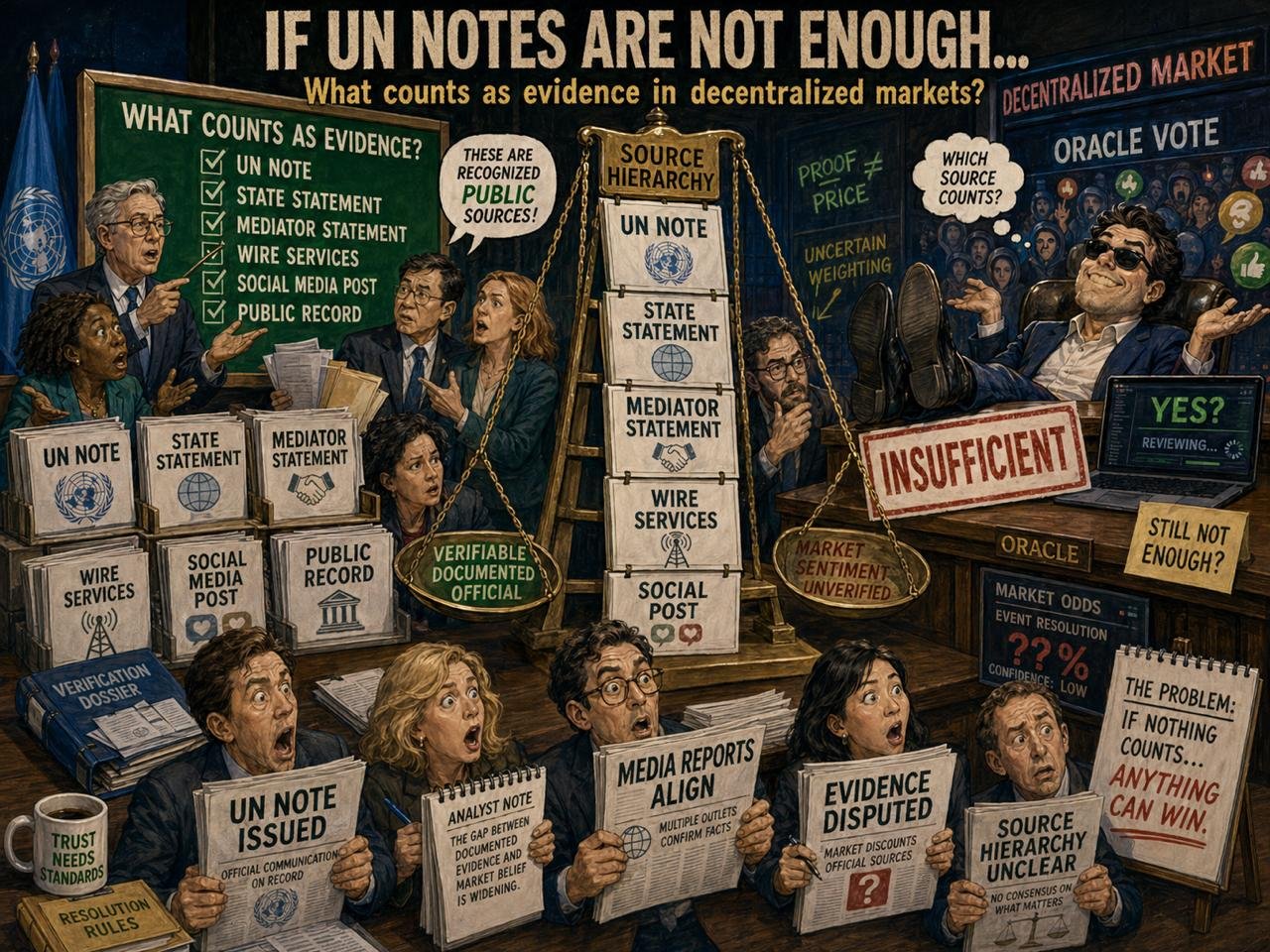
The evidence problem behind the Polymarket dispute
The dispute around Polymarket’s “US x Iran ceasefire extended by April 22, 2026” market has raised a question that goes beyond one contract: what should count as authoritative evidence in a decentralized market?
Prediction markets are built on the idea that uncertain events can be priced, traded and eventually resolved. In simple cases, this is relatively straightforward. A sports result, an election result or a published economic figure can usually be checked against one official source.
But geopolitical events are different. A ceasefire extension may be communicated through state statements, mediators, international organizations, diplomatic notes, wire services, and public media coverage. That makes the resolution problem less technical and more institutional.
This is the core issue: decentralized markets need explicit source hierarchies before disputes happen, not after millions of dollars are already at stake.
The case for official documents
In the US–Iran ceasefire dispute, Yes holders point to several categories of evidence: an official US statement, Pakistan’s confirmation as mediator, a UN Secretary-General Note to Correspondents, and reporting by major international media.
A UN note is not casual commentary. It is a formal institutional communication from one of the world’s central diplomatic bodies. For many observers, that should carry significant evidentiary weight, especially when paired with state statements and consistent media reporting.
The same applies to state communications. A direct government statement is usually among the strongest forms of evidence for political or diplomatic events. If a market asks whether a government took or recognized an action, official statements should sit near the top of the source hierarchy.
But the dispute shows that even “official” can be contested. Was the statement bilateral or unilateral? Did one side confirm directly or indirectly? Does a mediator’s confirmation count as a party’s confirmation? These are not technical questions. They are questions of legal and diplomatic interpretation.
The mediator problem
Mediator statements are particularly important in diplomatic conflicts.
In many negotiations, parties do not always communicate directly or publicly. They may rely on intermediaries to reduce political risk, preserve deniability or avoid escalation. In such cases, a mediator’s statement may be highly relevant evidence.
Yes holders argue that Pakistan’s role as mediator should make its confirmation meaningful for resolution purposes. If a recognized mediator confirms an extension, that is not equivalent to a random third-party comment.
But decentralized markets need to specify this clearly. Does a mediator’s statement count as official confirmation? Does it count only if both parties previously recognized the mediator’s mandate? Does it require no public denial from either side? Does it satisfy the rule only when paired with other evidence?
Without answers in the rules, the oracle is forced to decide after the fact.
Media consensus as a safety valve
Many prediction-market rules include a fallback criterion: credible media consensus. This makes sense. Markets cannot require perfect formal documentation for every real-world event. Public facts often emerge through reputable reporting before they are captured in official archives.
Wire services such as Reuters or AP, major international broadcasters, and established newspapers often function as practical evidence layers. They do not replace official sources, but they can corroborate and contextualize them.
The problem is that “media consensus” must be operationalized. How many outlets are enough? Which outlets qualify? What happens if reporting is widespread but based on the same original statement? What if articles report an extension but also note uncertainty about one party’s position?
If the rules say “overwhelming consensus of credible media reporting,” but do not define what that means, the clause becomes vulnerable to selective interpretation.
Social media posts and modern diplomacy
Modern state communication increasingly happens through social media. Presidents, ministers and official agencies often make major announcements on platforms such as X or Truth Social.
That creates another evidentiary challenge. Is an official social media post equivalent to a government statement? In some contexts, yes. In others, it may be treated as political messaging rather than formal policy communication.
Prediction markets need to decide this before trading begins. If official social media posts are accepted, the rules should say so. If they are only secondary evidence, that should also be clear.
The same logic applies to posts by mediators, diplomats and international organizations. In modern diplomacy, public communication is fragmented. Market rules must reflect that reality.
Why decentralized systems need source hierarchies
The larger problem is that decentralized markets often treat “truth” as if it can be discovered after the fact by a vote or dispute mechanism. But difficult political events require a hierarchy of sources.
A credible framework might rank evidence as follows: first, direct official documents or statements from relevant governments; second, formal communications from international organizations; third, recognized mediator statements; fourth, wire services and major media consensus; fifth, official social media posts; sixth, secondary commentary and analyst interpretation.
The exact order can be debated. The point is that the order should exist.
Without a hierarchy, every dispute becomes a fight over which source matters most. That creates uncertainty for traders and reputational risk for platforms.
Finality is not enough
Decentralized oracles can provide finality. They can produce an answer, distribute payouts and close the market.
But finality is not the same as legitimacy.
A market resolution is legitimate only if users understand why certain evidence was accepted and other evidence was rejected. If users believe that strong public sources were ignored, the result may be technically final but socially contested.
That matters for institutional adoption. Professional traders, funds and policy users can accept risk. They cannot easily accept unpredictable evidence standards.
What should change
Markets involving diplomacy, war, sanctions, ceasefires, elections and international organizations should not use vague evidence rules. They need stricter templates.
Those templates should define accepted source categories, rank them by authority, explain how media consensus is measured, state whether mediator confirmations count, clarify how official social media is treated, and describe what happens when sources conflict.
They should also disclose oracle risk directly: users are not only trading an event, but also the resolution methodology.
The lesson
The US–Iran ceasefire dispute shows that decentralized markets cannot rely on vague appeals to “credible sources” when high-stakes political facts are involved.
If UN notes, state statements, mediator confirmations and major media reports are not enough, the market must explain what would be enough. Otherwise, users are left trading inside an evidence system whose rules only become visible after the dispute begins.
For prediction markets to become serious truth infrastructure, they need more than liquidity and oracle finality. They need transparent standards for evidence.
Disclaimer: This article is provided for informational purposes only. It is not offered or intended to be used as legal, tax, investment, financial, or other advice.