












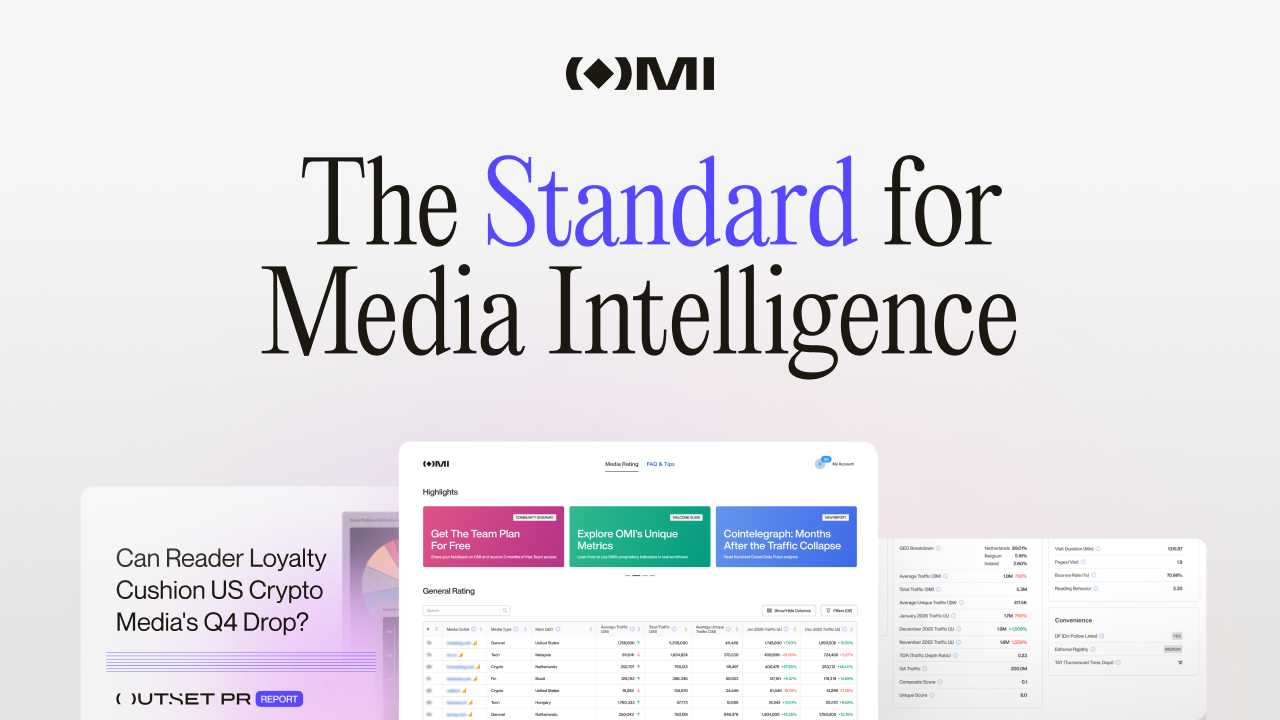
On March 12, Outset Media Index (OMI) entered its soft launch as a standardized benchmark designed to bring data-driven clarity to media analysis, an area where teams have long relied on fragmented traffic signals and limited visibility data. It currently indexes over 340 publications with regular crypto coverage, including niche outlets as well as finance, tech, and general news portals with dedicated crypto sections. The scoring framework is built to scale into other domains as the dataset expands.
OMI includes 37 performance and workflow metrics across reach, engagement, distribution dynamics, and collaboration factors. It combines partner data from sources such as Similarweb and Moz with proprietary research indicators that enrich traffic and SEO signals with practical context.
All inputs are reviewed and normalized to avoid inflated metrics and keep analysis consistent across outlets, with the same criteria applied throughout the index. Unlike existing media lists with non-transparent methodologies, OMI serves as an objective, unbiased infrastructure, where visibility in rankings is determined by real data, not hidden interests.
The launch comes as media discovery becomes harder to interpret across markets. The Reuters Institute recently cited a Chartbeat report showing Google organic search traffic to news sites down by roughly 33% globally between November 2024 and November 2025. Meanwhile, publishers expect referrals to fall by another 43% over the next three years as AI summaries and chat-style search expand.
In that context, traffic spikes and SEO rankings alone increasingly fail to show whether a media actually holds value. They reveal little about how steady an outlet’s audience really is, how readers engage once they arrive, whether coverage travels beyond the original publication, or which operational nuances matter when planning media outreach.
OMI brings those signals into one organized framework, giving teams running media operations, including advertisers, media buyers, in-house PR and marketing units, agencies, publishers, and researchers, a clearer reference point for analyzing outlets, planning growth strategies, and allocating budgets responsibly.
Alongside familiar metrics, OMI introduces proprietary indicators that reflect how visibility behaves in practice. These signals focus not only on audience size, but also on stability, reader engagement, and how coverage spreads after publication.
A few examples illustrate how the framework works:
-
Unique Score tracks consistent unique readership across several months, allowing teams to distinguish outlets with durable audiences from those driven mainly by short traffic spikes.
-
Reading Behavior combines indicators such as time on page, pages per visit, and bounce rate to show where audiences actually interact with content once they click.
-
Reprints indicates how often articles are picked up by aggregators or secondary outlets, helping identify platforms where coverage tends to trigger quality syndication.
These and other indicators feed into two summary frameworks within the index: General Rating, reflecting overall outlet performance, and Convenience Rating, which captures operational factors that affect day-to-day collaboration, such as editorial flexibility, turnaround speed, and price-to-reach alignment.
Within the platform, outlets can be reviewed side by side, filtered by parameters tied to business impact, and explored through detailed media profiles with historical context – enabling straightforward integration of OMI into different tasks, processes, and use cases.
During the soft launch, access is being rolled out in a controlled way to create room for iteration. The focus of this phase is practical collaboration: working with partners and active users to test real workflows, validate assumptions, and further refine the index based on feedback. Participants who contribute insights during this period will be recognized and rewarded for helping shape the platform’s direction ahead of wider availability.
OMI is part of a broader analytical ecosystem developed by Outset PR. Within that structure, the index works alongside Outset Data Pulse (ODP), which is undergoing a rebrand to become its research and interpretation layer.
Sofia Belotskaia, product lead at Outset Media Index, clarifies: “Data on its own rarely helps unless it is comparable. While OMI shows how media performance and distribution patterns evolve across outlets, ODP focuses on explaining why those changes happen and what they mean for teams working across the media market.”
The index is also supported by a set of Outset PR’s infrastructure tools. These tools include a syndication map that follows how articles move through aggregator feeds and secondary outlets, as well as an internal media parser that automates republication tracking so distribution patterns can be analyzed at scale.
Mike Ermolaev, founder of Outset PR, says the goal of OMI is to keep media work “a human craft first,” while backing it with “clear tracking, reliable media intelligence, and systems that help people understand that visibility is not a matter of luck – it’s a system that can be engineered, controlled, and measured.”
In 2026, the agency plans to bring these analytical layers closer together, making media data easier to use in everyday workflows without relying on scattered spreadsheets or isolated dashboards.
About Outset Media Index
Outset Media Index, or OMI, is the first standardized benchmark for media outlets developed by Outset PR. It brings data-driven clarity and structured analysis to how media markets are understood across niches. The platform is used by teams who need meaningful context when planning media activity, allocating budgets, or interpreting how visibility behaves after publication.
By organizing performance, engagement, distribution, and operational signals within a single analytical framework, it provides a reliable picture of how outlets actually perform beyond surface traffic indicators. Alongside familiar metrics, OMI introduces exclusive decision-ready parameters around audience quality, distribution patterns, and collaboration dynamics – built on years of team’s experience in media analytics.
The methodology is transparent, consistent, and non-negotiable, with no paid rankings or visibility boosts.
Contacts
Business inquiries: sales@omindex.io
Media inquiries: media@omindex.io
Telegram: t.me/omindex