












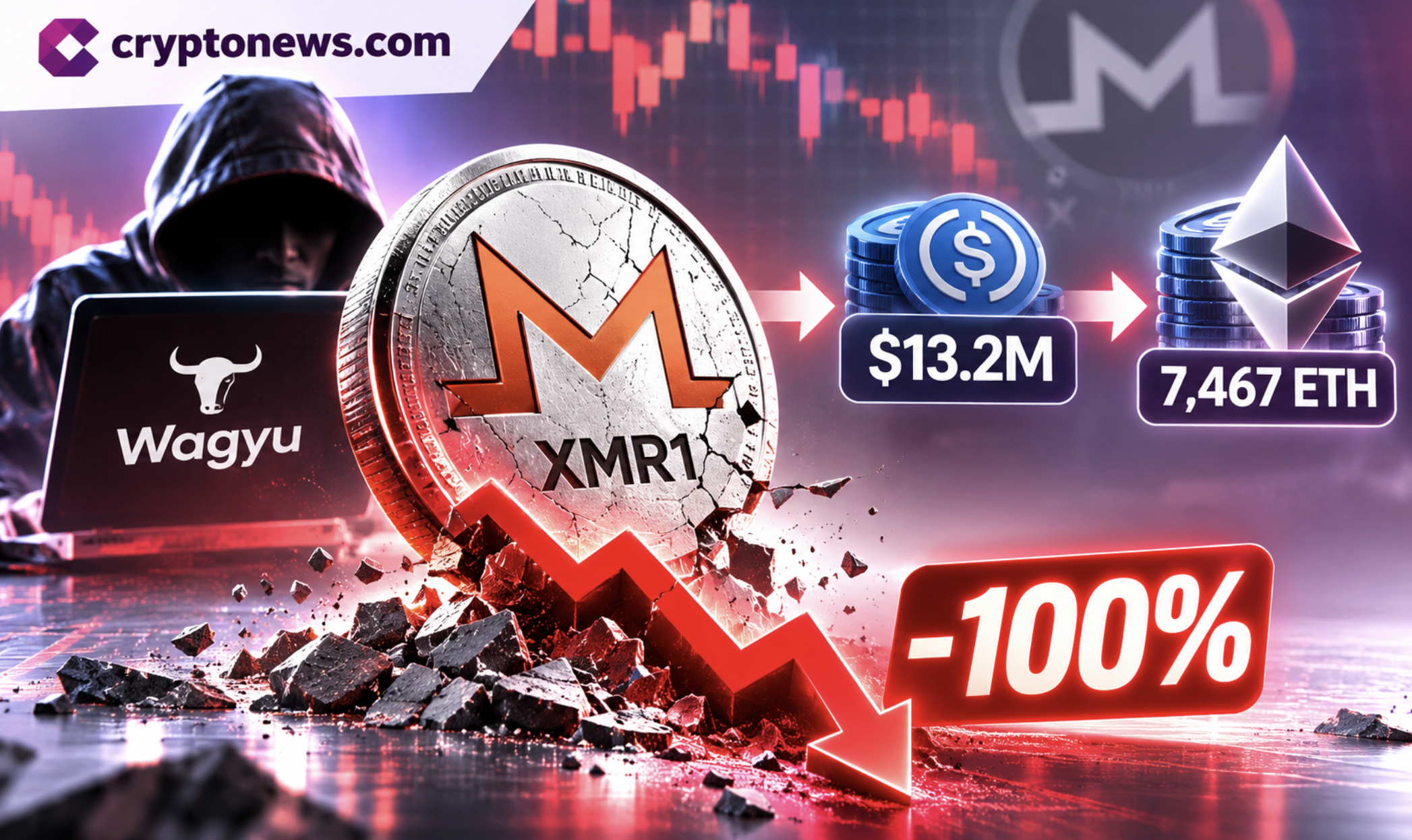
A Monero token crashed 99% on Friday after 5.2 million XMR1 tokens moved from a wallet tied to its creator, triggering a massive sell-off on Hyperliquid. The token, issued through crypto swap service Wagyu, plunged from around $494 to below $1 in 35 minutes. The wallet receiving the tokens sold enough to generate $13.22 million in USDC before converting the proceeds into 7,467 ETH.
Wagyu’s wallet security and the backing behind its wrapped Monero product are being questioned. And the sell-off also sent shockwaves through the Monero market, although native XMR remained a separate asset from the collapsing XMR1 market.
— Crypto Banter (@crypto_banter) November 20, 2026
HYPERLIQUID WRAPPED MONERO APPEARS TO BE GETTING HACKED!@lookonchain flagged an attacker wallet that received 5.2 million $XMR1, dumped it on Hyperliquid, then used the proceeds to buy ethereum:native.
So far the address has spent $13.22M USDC for 7,467 ethereum:native.… pic.twitter.com/boP1oXXmjl
Wagyu-Linked Wallet Moves 5.2 Million XMR1 Before Crash
The incident began this morning when the account responsible for deploying XMR1 transferred tokens to a newly created wallet. Blockchain intelligence firm Bitquery identified three separate transfers between 04:46 and 05:16 UTC. Two transactions moved 100,000 XMR1 each, followed by a much larger transfer of 5 million tokens.
The receiving wallet had been created that morning. It began selling shortly after receiving the tokens, overwhelming buyers on Hyperliquid’s order book. XMR1 had traded near $500 throughout the previous week. Its price then collapsed to $1 within 30 minutes, leaving holders with almost nothing.

Bitquery traced 363,804 tokens sold for $13.5 million. The remaining 4.83 million tokens stayed in the receiving wallet during its investigation. The sell-off also exposed how concentrated XMR1’s supply had been. Before the transfers, its deployer account still controlled 93% of the token’s supply.
Hyperliquid transfers require signatures from the account’s own key, rather than an ordinary trading API wallet. This means whoever authorized the transfers likely had access to the deployer’s main key. Whether someone stole that access or used it legitimately remains unknown.
Discover: The Best Token Presales
388 Buyers Pay $13.5 Million as Proceeds Move Into Ethereum
The damage extended beyond traders watching XMR1 collapse on their screens. It matched the seller’s transactions against 388 accounts that purchased the dumped tokens. One buyer alone paid $3.56 million, while 27 large buyers accounted for 77% of the total proceeds.
The wallet did not leave the money sitting in USDC. It began moving funds through Hyperliquid’s bridge into Arbitrum shortly after selling.
On Arbitrum, the wallet exchanged $13.22 million in USDC for 7,467 ETH through CoW Protocol. It then routed much of the Ethereum through Socket, Mayan, and Stargate. 6,810 ETH then arrived on Ethereum after those bridge transactions. Approximately 4,836 ETH landed in a newly created wallet that had not sent any funds onward.
The investigation also identified 7,348 ETH across three wallets during its tracking window. That left a substantial amount of the proceeds sitting outside the original trading account.
Native Monero Avoids Collapse as Wagyu and Hyperliquid Face Security Questions

The incident has put Wagyu’s bridge infrastructure under scrutiny. XMR1 itself is Monero on Hyperliquid, but through Wagyu’s bridging service. Users can move native XMR into the service and receive XMR1 for trading. They can also reverse the process to recover their Monero.
Native XMR did not suffer the same collapse. Monero continued trading around $470–$482, while XMR1 lost virtually all its market value.
Holders now face a difficult question: Can they still exchange their remaining XMR1 for native Monero?
The incident also comes weeks after Wagyu disclosed a separate data leak on October 28. Researchers identified exposed records potentially linking crypto deposits, Monero receiving addresses, and customer IP addresses.
Wagyu previously said customer funds remained unaffected by that incident. No established connection links the October leak to Friday’s wallet transfers.
The latest investigation also uncovered another potential concern. The same deployer account controls 99.97% of ZEC1, a separate token representing Zcash on Hyperliquid.
Discover: The Crypto Presales This Q4 2026
Source: Crypto News