












AI can summarise an article, but it cannot summarise the room. The value of a conference is moving from footfall to the online trail. When BeInCrypto covered TOKEN2049 Singapore, almost half of the readership came after the event ended, and 46% read it in a language other than English (BeInCrypto analysis, November 2026).
For decades, conferences were measured by footfall: badges scanned, booths visited, leads collected. Those metrics still matter, but they only count the people who are in the room on the day. Everyone else, from investors and regulators to customers in other markets, learn about the event later through what was published about it. Nowadays, more and more online content gets accessed through AI search. Six in ten US adults now read the AI summaries at the top of search results (Pew Research Center, June 2026).
Publishers are betting on events
Media companies are putting money behind live events. In the Reuters Institute’s 2026 survey of 280 news leaders across 51 countries, published in January 2026, 54% of commercial publishers named online and in-person events as an important revenue stream for the year ahead.

The publishers furthest ahead show how big the business can get:
| Publisher | Events metric | Source |
| Financial Times (FT Live) | More than 300 events run; 86,000+ attendees from 175 countries in 2024, 46% at VP level or above; around £60m revenue in 2024, double 2021; events grew from 5% to 10% of FT revenue since 2012 | FT Strategies, 2025 |
| Semafor | About half of revenue from live events; first profitable year in 2025, on $40m revenue | Nieman Lab, October 2026 |
| Time | Events and the digital revenue around them expected to make up half of 2026 revenue, up from 28% in 2023; 47 events planned in 2026, up from 11 in 2022 | TheWrap, August 2026 |
| Axios | 160 events in 2025; Axios Live revenue up more than 30% so far in 2026, its fastest-growing business | TheWrap, August 2026 |
| Condé Nast | Events revenue up 40% in 2025, with another 22% expected in 2026 | Adweek, May 2026 |
| Globo | Events bring in 32% of company revenue, across more than 200 productions a year | INMA, August 2026 |
| The Atlantic | Moved from more than 100 events a year a decade ago to a smaller slate of tentpole events; advertising revenue, including event sponsorship, up nearly 60% since 2023 | TheWrap, August 2026 |
What sponsors are paying for
Fortune’s event sponsorship revenue is up 30% year on year even though ticket revenue was flat (A Media Operator, October 2026). Digiday+ research found events overtaking subscriptions among the revenue sources publishers cite most in 2026 (INMA, August 2026).
Some organisers now run their events as journalism. Semafor calls its programme “live journalism” (FT Strategies), and Time judges each event partly on whether it produces journalism and gets people talking beyond the venue (TheWrap, August 2026).
Sponsors tend to point to the editorial side. Horizon Sports & Experiences founder Chris Weil told TheWrap in August 2026 that publisher-led events bring editorial credibility and amplification before, during and after the event, which standalone brand activations lack. That advantage only holds while sponsorship and coverage stay visibly separate.
Not every part of the market is growing. Cost pressure is the biggest external challenge for 85% of the 240 senior meetings and events leaders surveyed for BCD Meetings & Events’ 2026 Global Client Survey (June 2026), and 40% of organisers in Bizzabo’s 2026 benchmark still struggle to prove return on investment (Bizzabo, 2026). Media brands feel the crowding too: Inc.’s editorial director told BizBash in November 2026 that the publisher watches closely for signs of event saturation and adjusts what it puts on.
Events are becoming media brands
The shift also runs the other way. Some event organisers without a newsroom of their own are building media operations around their conferences.
Money20/20, the fintech event series, co-produces Taking Stock, a daily closing-bell show broadcast from the New York Stock Exchange floor with NYSE, FINTECH.TV and Cheddar, which also reports on location from fintech events (Money20/20, June 2025). It runs The MoneyPot podcast alongside and records episodes in booths on its show floors (Money20/20, 2026).
The World Economic Forum runs a podcast network around its meetings. Radio Davos publishes live from the Annual Meeting, and Agenda Dialogues releases the full audio of panel sessions (World Economic Forum, 2026).
In the digital assets space, the line between publisher and organiser has long been thin. CoinDesk runs Consensus, and BTC Inc, which publishes Bitcoin Magazine, organises the Bitcoin Conference, whose 2026 Las Vegas edition drew more than 40,000 attendees (crypto.news, April 2026). Blockworks, which started as a media and events company, has since closed its news division to focus on data, but still runs its Digital Asset Summit.
What happens to event content after the event
For companies on stage, what an event publishes now has a second audience: the AI systems that answer questions about their industry. About 84% of the links AI assistants cite come from earned media such as journalism, research and third-party analysis, while press releases and paid content together account for roughly 1% (Muck Rack, What Is AI Reading?, October 2026, based on more than 40 million AI responses).
The type of content matters too. When people ask AI about industry trends, expert analysis makes up 41% of citations, recent news 18% and data and research 14% (Muck Rack, October 2026). Those map closely to what a well-covered event produces: on-the-record interviews, same-day reporting and research launched in the room.

How widely a company is discussed also matters. In Ahrefs’ study of 75,000 brands, the number of times a brand was mentioned across the web was the factor most closely linked to its visibility in Google’s AI Overviews, ahead of backlinks and ad spend (Ahrefs, May 2025). A follow-up found mentions on YouTube, in video titles, descriptions and transcripts, were even more closely linked to visibility in ChatGPT, Google AI Mode and AI Overviews (Ahrefs, December 2025). Ahrefs is clear that these are correlations, not proof that more mentions cause more AI visibility.

Specialist outlets count as well. Claude, Gemini and Perplexity mostly cite news outlets with fewer than one million monthly visitors, while ChatGPT favours larger newsrooms (Muck Rack, October 2026).
Case study: what one NewsDesk produced
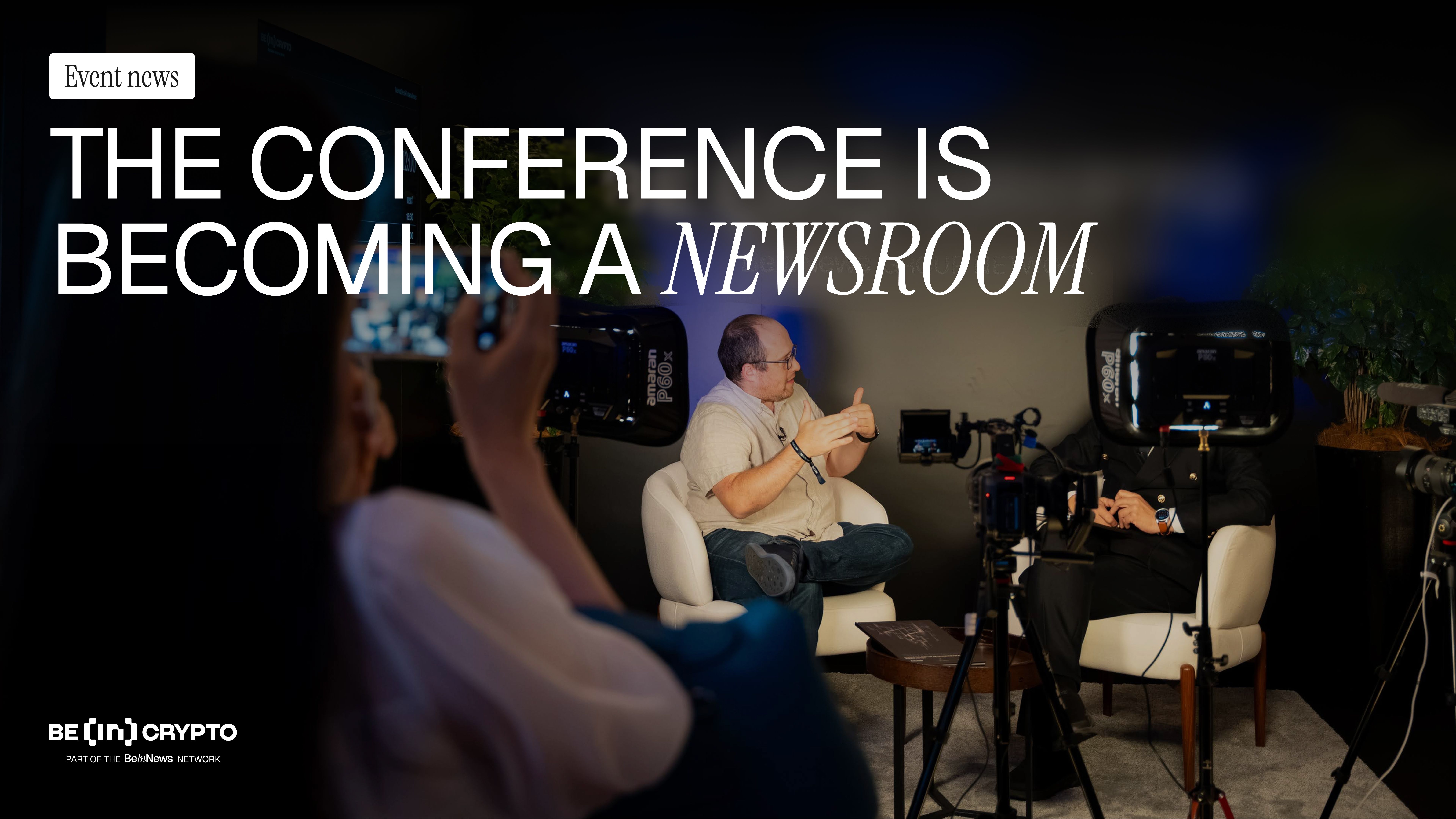
BeInCrypto’s NewsDesk at TOKEN2049 Singapore in October 2026 shows how this works in practice. Over two days, we recorded 24 video interviews with executives from Fireblocks, Chainlink Labs, Coinbase, Kaiko and Stripe-owned Privy, alongside Kalshi, Arkham, Dune, MEXC and Babylon Labs.
Published on YouTube, then cut for social channels and newsletters, the 24 interviews became 56 videos, clips and newsletter features. In total, our coverage of the event ran to 117 pieces across 26 language editions, newsletters and social channels, with a potential reach of more than 8.8 million across those channels (Source: BeInCrypto analysis, November 2026).
The coverage kept working after the doors closed. Almost half (49%) of the readership of our TOKEN2049 articles came after the event ended, and the article announcing The State of AI Agent Payments 2026, which we launched at the NewsDesk, earned 83% of its views after the event.
It also travelled well beyond English: 46% of readers read our coverage in a language other than English, across 25 language editions, rising to 68% for our newsroom’s reporting from the event floor. The Indonesian, Korean, German and Japanese editions led (Source: BeInCrypto analysis of first-party analytics, 1 August to 24 November 2026; excludes sponsored releases).
Four questions to ask before your next event
- Who is reporting from the room? A journalist on site turns conversations into coverage during the event itself.
- What goes on the record? Moderated panels and interviews produce quotes and context that others can cite.
- In how many languages will it travel? Coverage in your audience’s own languages reaches markets far beyond the host city.
- What exists a month later? Reports, articles and video are still being read, watched and cited a month on.
Help us measure it
Do you organise events, manage event sponsorships in a brand’s marketing team, or work at an agency that does either? As part of its Business of Media Council, BeInCrypto is studying how media, events and search are changing the way audiences find and trust information. This survey looks at how event organisers and sponsors measure the value of their events and the content they produce.
The survey takes about five minutes and closes on 15 December 2026. Answers are anonymous, and anyone who leaves their email at the end will receive the full findings, with a benchmark of their answers against peers, before we publish them in January 2027.
BeInCrypto is part of the BeInNews Academy Ltd, an independent media group covering the convergence of finance and digital assets. We help professionals act with confidence in a complex and fast-changing industry through our newsroom, research reports, events, expert network and multimedia studio.
Source: BeInCrypto